
Planning
What to include on a wedding invitation, and what can wait
7 min read
Updated
The five things every invitation must say, the details that can wait for later, and a checklist that shows where each one belongs, on paper or on screen.
A wedding invitation must say who is inviting, who is marrying, when, where, and how and by when to reply. Everything else, from the dress code to the hotels, can wait for a details card, a second page or a wedding website, where guests will find it when they need it.
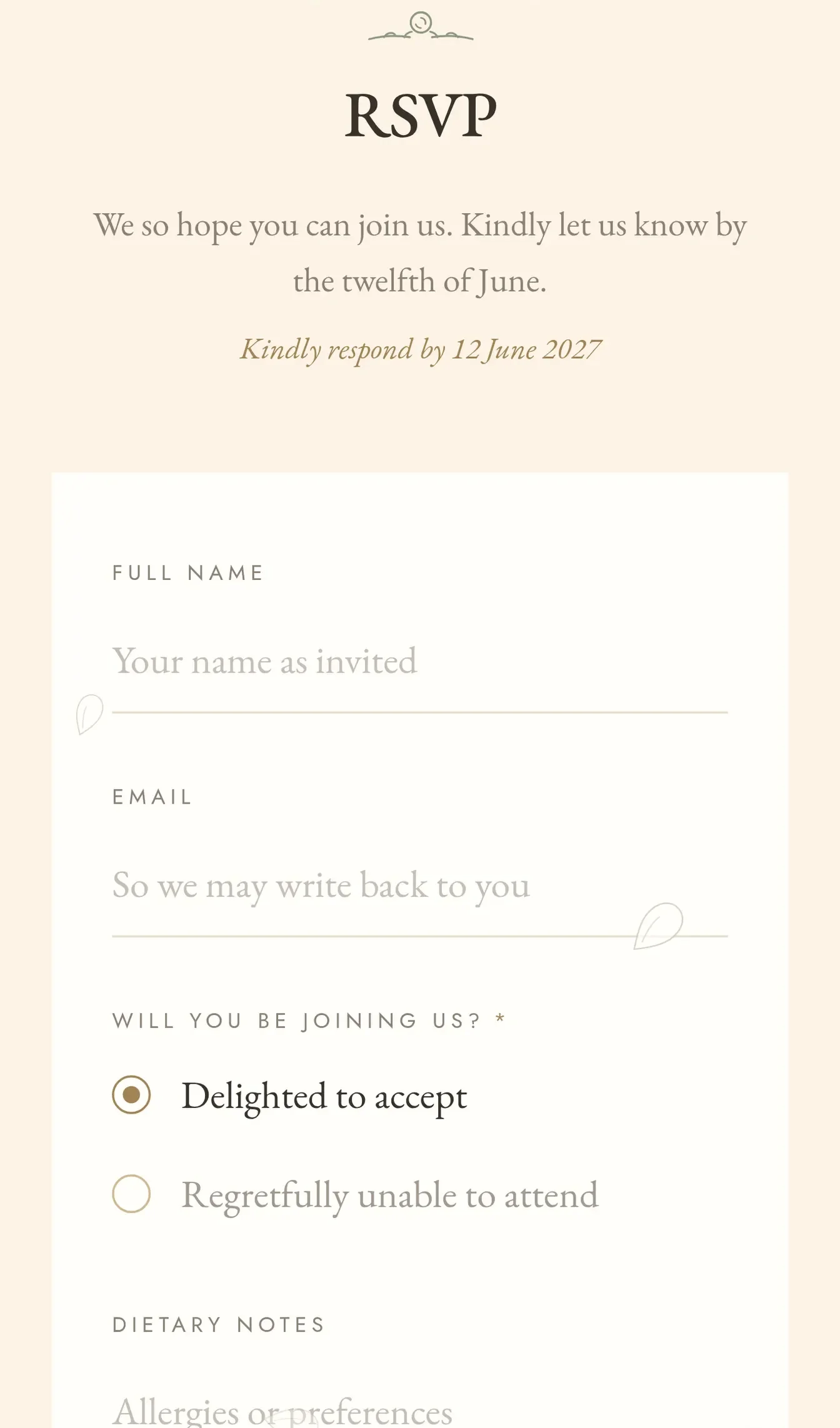
What are the five things every wedding invitation must say?
Here they are in the order a guest reads them.
- Who is inviting. Your parents, one set of parents, or the two of you. The traditional form names the host first. If you are hosting yourselves, your own names do that job.
- Who is marrying. Your full names, or the first names your guests know you by. Match the formality of the hosting line.
- When. The day of the week, the date and the time the ceremony starts. “Saturday 4 September 2027 at two o’clock” leaves no room for doubt. A date without the day of the week is easy to misread.
- Where. The name of the venue and the town. The full address and the parking can go with the details.
- How to reply, and by when. A reply date and the way to answer: a reply card, an email address, a website or the reply form on a digital invitation.
Between the host and your names sits the request line, the sentence that turns a list of facts into an invitation. “Request the pleasure of your company” is the traditional formal choice. “Would love you to join us” is the warm one. Our wedding invitation wording examples have a version for most families.

Which details can wait for the next page?
The order of the day, travel, hotels and gifts can all wait. Each of them helps a guest, yet none decides whether the guest can come. On paper they go on a details card in the same envelope, or on a wedding website whose address is printed at the foot of the invitation. On a digital invitation they get a page of their own.
Either way, guests come back to them in the week before the wedding, usually to check the parking. Say, too, when the celebrations will end. It is a small kindness to anyone booking a taxi from a village with one taxi.
Which details change who comes?
Two details do: whether children are invited, and whether a guest’s partner is. A guest needs both answers before replying, so settle them before you send anything. The clearest answer is the names you use. Greet exactly the people you are inviting, on the envelope or in the message that carries your link, and write each household in your guest list the same way.
Then ask on the reply for the name of everyone who is coming, so a reply that does not match stands out at once. The wording for both cases is in our guides to adults only wedding invitation wording and plus one wedding invitation wording.
Where does each detail go?
Here is the full list, as a checklist you can work through with a pen. The first seven rows belong on the invitation itself, on paper or on screen. The rest can live with the details.
What goes on a wedding invitation, and where
Who is hosting
- Must or nice
- Must
- Where it goes
- The first lines of the invitation
Your names
- Must or nice
- Must
- Where it goes
- The invitation itself
The request line
- Must or nice
- Must
- Where it goes
- Between the hosts and your names
Date, with the day of the week
- Must or nice
- Must
- Where it goes
- The invitation itself
Ceremony start time
- Must or nice
- Must
- Where it goes
- The invitation itself; the full order of the day with the details
Venue and town
- Must or nice
- Must
- Where it goes
- The invitation itself; the address and parking with the details
Reply date and how to reply
- Must or nice
- Must
- Where it goes
- The invitation, and again on the reply card or form
Dress code
- Must or nice
- Only if you have one
- Where it goes
- One line near the end of the invitation, with more in the details
Children
- Must or nice
- Must if the day is adults only
- Where it goes
- The names you invite, and one kind line in the details
Plus ones
- Must or nice
- Must if a partner is not invited
- Where it goes
- The names you invite, and the reply
Travel and hotels
- Must or nice
- Nice, and a must for a wedding abroad
- Where it goes
- A details card, a second page or a website
Gifts
- Must or nice
- Nice
- Where it goes
- The details, never the front of the invitation
Do you need to put a dress code on the invitation?
Only if you mean something specific by it. If you have no dress code, leave the line out, because people dress up for weddings without being asked. If you want black tie, morning dress or a colour, name it in one line near the end of the invitation, with one practical note about the place. Our guide to wedding dress code wording has a line for each code.
How should you word the gift note?
Keep it short, warm and specific, and put it with the details: “Your company is the gift. If you would like to give something, we are saving for our first home.” Nobody minds reading it in the details. Some people mind reading it above the date.
How do you collect all of this before you write?
Make two lists. The first is everything you need to know from your guests: who is coming, meal choices, dietary needs and any question of your own, such as one about access. That list becomes your reply card or reply form. The second is everything your guests need to know from you, and it becomes the invitation and its details.
Fill in both before you speak to a stationer or a designer. The brief then takes an evening, not a month of emails.
Which detail is easiest to forget?
The reply date. It is easy to leave it as an afterthought, and then spend weeks chasing replies. Ask your venue when it needs final numbers, and set your reply date about two weeks before that. Our guide on when to send wedding invitations in the UK works back from that date. Then check that the reply date sits beside the way to reply, where every guest will see it.
Before you write anything else, put the five essentials on one sheet of paper and read them aloud to someone who is not getting married. If they can repeat them back, you are ready for our wording examples, line by line.
Questions couples ask
Do you put the full venue address on a wedding invitation?
Put the venue’s name and its town on the invitation itself. The full address, the postcode for a satnav and the parking belong on a details card, a second page or your website. Guests look for them in the week before the wedding, not on the day they reply.
Should the time on the invitation be the ceremony time?
Yes. Print the time the ceremony starts, and ask guests to arrive a little earlier in the details, for example “please be seated by 1.40pm”. A guest who reads “two o’clock” will plan to walk in at two.
Do you still need a reply card?
On paper, a reply card or a reply email address makes replying easy, and an easy reply comes back sooner. On a digital invitation, the reply form does the same job. Either way, print the reply date beside the way to reply.
Where do the gift list details go?
With the details or on your website, never on the front of the invitation. Keep the note short and warm, and say what a gift of money is for if you would welcome one. Guests who want to give something will look for it.

When you are ready
Create your digital wedding invitation
Choose a design from our collections, and we make it yours: your names, your words, your day. Guests open it on their phone, reply inside the invitation, and every answer lands in your guest list. Two languages at no extra cost. Paid once per wedding, from £149.
Every design opens on your phone as your guests will see it. How it works
Keep reading

Planning
How to plan an event, step by step, from the date to the thank-you notes
Eight steps in the right order, a checklist counted back from the day, a budget split and a timeline, for a birthday, an anniversary or any party.

Planning
How far ahead to plan a party in the UK, and when to send the invitations
Start dates, venue bookings and reply dates for seven kinds of party, with what 50th birthday venues ask and when to book a work Christmas party.

Planning
Where to spend your wedding budget, and what nobody will miss
Photographs and film first, then the food and comfort your guests feel, then the cuts nobody notices: a clear order for the money, line by line.

Planning
What a UK wedding costs in 2026, line by line
Two national surveys side by side, the average for each supplier, the real cost of one more guest, and a budget method with room for surprises.