
Wording
Wedding invitation wording examples, line by line
8 min read
Updated
Lines to copy for every part of the card and every kind of day: the hosts, the request, the date, evening guests, a second marriage and gifts.
Good wedding invitation wording follows one order: who is inviting, the request, your names, the date and time, the place, then how to reply. Choose the hosting line that is true for your family, write the date in words for a formal wedding, and keep everything else for the details page.
Most couples write their wording in an evening and then rewrite it for a month. The old examples assume one set of parents paying for everything, and most weddings are not like that now. Every line below uses one invented couple, Hannah Clarke and Sam Okafor, marrying on Saturday 18 September 2027.
Who should the invitation come from?
From the people who are hosting, which is not always the people who are paying. Pick the version that is true for you.
- You are hosting yourselves: “Hannah Clarke and Sam Okafor invite you to celebrate their marriage”
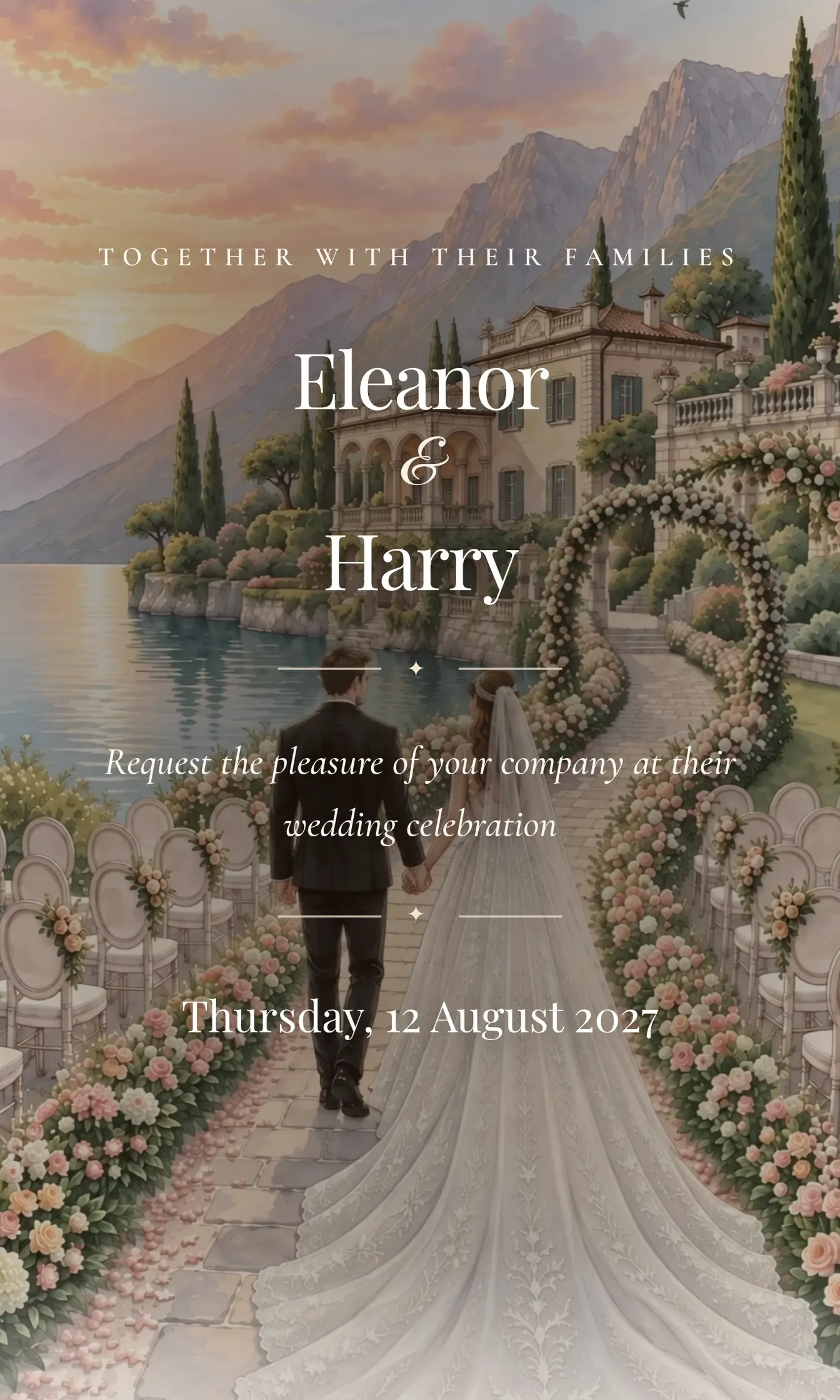
- Both families are hosting: “Together with their families, Hannah Clarke and Sam Okafor invite you to celebrate their marriage”
- One set of parents is hosting, in the traditional form: “Mr and Mrs Peter Clarke request the pleasure of your company at the marriage of their daughter Hannah to Mr Sam Okafor”
If your parents are divorced, or there are step-parents to include, give each host their own line. Nobody minds a longer invitation. People do mind being left off one. There is a line for every family shape in our guide to wedding invitation wording for divorced parents.

Which request line should you use?
Use “request the pleasure of your company” unless you have a reason not to. It is the classic British phrase and suits almost any wedding. Read your choice out loud: if neither of you would ever say it, change it.
Which request line suits which wedding
A church or other religious ceremony
- The request line
- request the honour of your presence
- A note
- The grander form, kept for a place of worship
A civil ceremony, a hotel or a country house
- The request line
- request the pleasure of your company
- A note
- Correct almost everywhere
A relaxed day, or one you host yourselves
- The request line
- invite you to celebrate with them
- A note
- Warm, and still correct
A barbecue, a pub or a garden party
- The request line
- would love you to join them
- A note
- Fine when the day is informal
The evening reception only
- The request line
- invite you to join them for the evening celebration
- A note
- Give the start time and say whether there is food
How do you write the names, date, time and place?
- Names in the order that sounds natural when you say them together, and in the same style: both with titles, or neither.
- For a formal wedding, the date in words: “Saturday the eighteenth of September, two thousand and twenty-seven”. For a relaxed one, “Saturday 18 September 2027” is fine.
- The time the ceremony begins, in words for a formal card (“at two o’clock”). If you want people seated twenty minutes early, say so on the details page.
- The venue name, then the town. The full address and the map belong on the details page.
Where does the dress code go?
In one useful line after the place, before the reply line. “Black tie” on its own sends half your guests to a search engine. “Black tie. The ceremony is on the lawn, so bring shoes that can cope with grass” answers the question they were about to ask. Our guide to wedding dress code wording has a line for each code.
What should the reply line say?
A date and a way to reply, and nothing else. Ask your venue and caterer when they need final numbers, then set your reply date about two weeks before theirs. Our guide on when to send wedding invitations works back from that date. Lines to copy:
- Formal, on paper: “The favour of a reply is requested by Sunday 1 August 2027”
- Relaxed, on paper: “Please reply to Hannah by 1 August, by email or by phone”
- On a page with a reply form: “Please reply by 1 August”
How do you word an evening invitation?
Make it a full invitation of its own, not a smaller copy of the day one. Say what the evening is, when it starts and whether food is served, so nobody arrives hungry at nine expecting dinner.
- “Hannah Clarke and Sam Okafor invite you to join them for their evening reception on Saturday 18 September 2027, from half past seven, at the Mill House, Ludlow. Food and dancing until midnight.”
- If parents host: “Mr and Mrs Peter Clarke request the pleasure of your company at the evening reception to celebrate the marriage of their daughter Hannah and Sam Okafor”
Send the evening invitations on the same day as the day invitations, with the same reply date. A friend who receives theirs a month later will notice.
What changes for a religious ceremony?
Name the place of worship in full, and ask your minister, rabbi, imam or priest whether there is a customary form. Many will gladly tell you. Two lines that often help:
- “Mr and Mrs Peter Clarke request the honour of your presence at the marriage of their daughter Hannah to Mr Sam Okafor at St Laurence’s Church, Ludlow”
- A blessing after a civil ceremony: “Hannah and Sam invite you to the blessing of their marriage at St Laurence’s Church, Ludlow, following their civil ceremony”
How do you word a second marriage?
Usually the couple host it themselves, and the wording is simpler for it. A bride does not have to use a former husband’s surname or her old title. If you have children, inviting with them is lovely:
- “Together with their children, Lucy, Tom and Ava, Claire Bennett and David Shah invite you to celebrate their marriage”
Whose name goes first for a same-sex couple?
There is no rule, so choose the order that sounds best when you say the names aloud, or go by the alphabet. If one family is hosting, their child’s name usually comes first. Whatever you choose, give both names the same style, with titles or without: “Ella Morgan and Grace Lin invite you to celebrate their marriage”.
How do you invite people to a party after a small wedding?
Say plainly that you are already married, then invite. Guests like to know they did not miss the ceremony by accident.
- “Hannah and Sam were married in Edinburgh in May, just the two of them. Now they would love to celebrate with you, on Saturday 18 September 2027 at the Mill House, Ludlow.”
How do you mention gifts without sounding demanding?
Keep gifts off the invitation itself and put one kind line on the details page, never a sum of money. Three versions to copy:
- A gift list: “Your company is the only gift we need. If you would like to give something, our list is here.”
- Money: “We already have a home full of everything we need. If you would like to give a gift, a contribution towards our honeymoon would be lovely.”
- No gifts: “Please, no gifts. Having you with us is the present.”
How do you say adults only, or who may bring a guest?
Adults only: “We have decided to keep our day for adults only, and we hope you enjoy the night off.” It is kind and clear, and it gives nobody an opening to ask for an exception. Our guide to adults only wedding invitation wording covers babies, family and the guest who asks.
Plus ones: name every person who is invited. If someone may bring a partner you have not met, write “and guest” on their invitation, and leave it off everyone else’s. Our guide to plus one wedding invitation wording has the full table.
What do you do with a finished draft?
Read the whole thing out loud once, slowly. Wherever you stumble, a guest will too. Then check every name against how that person spells it, and every date against a calendar, and send the draft to whoever is setting it, rough or finished. A good designer or stationer will ask about anything unclear.
Once the words are settled, the rest of the card is easier, and our checklist of what to include on a wedding invitation covers everything that goes around them.
Questions couples ask
Should the bride’s name come first on a wedding invitation?
Traditionally, yes, when her parents are hosting. When you host together, either order is correct, so choose the one that sounds natural when you say it. Keep the same order on every piece of stationery.
Do you write the date in words on a wedding invitation?
On a formal invitation, yes: “Saturday the eighteenth of September, two thousand and twenty-seven”. On a relaxed one, “Saturday 18 September 2027” is fine. Never write the date in numbers alone, because guests abroad may read the day and month the other way round.
Is it rude to mention gifts on a wedding invitation?
On the invitation itself, most British etiquette says yes. Put one kind line on the details page or a separate card instead. Never name a sum of money.
What is the difference between a day and an evening invitation?
Day guests are invited to the ceremony, the meal and the evening. Evening guests are invited to the reception only, so their invitation gives its own start time and says whether food is served. Send both on the same day.

When you are ready
Create your digital wedding invitation
Choose a design from our collections, and we make it yours: your names, your words, your day. Guests open it on their phone, reply inside the invitation, and every answer lands in your guest list. Two languages at no extra cost. Paid once per wedding, from £149.
Every design opens on your phone as your guests will see it. How it works
Keep reading

Wording
Adults only wedding invitation wording, said kindly
Let the names do the work, add one warm line, and word each exception so that every parent can see the rule. Adults only wording that stays kind.

Wording
Plus one wedding invitation wording: who gets one, and how to say so
Name every partner you know, write “and guest” only when you mean it, and reply kindly when someone asks to bring a date. Plus one lines to copy.

Wording
Wedding dress code wording, in one line your guests will thank you for
Name the code, then add one line about the place. A UK table from white tie to garden formal, with dress code lines your guests can act on.

Wording
Wedding invitation wording for divorced parents and blended families
Who to name, and in what order, when parents have divorced, remarried or died, with lines to copy for each family and every step-parent.