
Planning
How to plan an event, step by step, from the date to the thank-you notes
9 min read
Eight steps in the right order, a checklist counted back from the day, a budget split and a timeline, for a birthday, an anniversary or any party.
Plan an event in this order: fix the date, the budget and the guest number first, because every other choice depends on them. Then book the venue and the food, send the invitations, chase the replies, give the final numbers two weeks before, and write a timeline for the day so that everyone knows what happens when.
The order holds for a tea for twelve in the garden and for a 40th for sixty in a hired room. The bigger party only starts earlier.
What is the order of work for any event?
Eight steps, in order. Each needs the answer to the one before.
- Fix the date, the budget and the guest number.
- Book the venue, or decide that the party is at home.
- Book the food and the drink, then any music or a photographer.
- Send a save the date to the guests who must be there, if they must travel or the date is busy.
- Send the invitations, with a date to reply by.
- Chase the replies, then give the final numbers and the dietary needs to the caterer.
- Write a timeline for the day, and send it to everyone who has a job.
- Afterwards, pay the last bills and send the thank-you notes.
The first step is the easiest to skip. Agree the three numbers with whoever hosts or pays with you, and write them where you will keep everything else, because the guest number decides the room, the room decides which dates are free, and the budget decides both. A notebook works. So does a spreadsheet, or our event planner, which turns your date into a checklist with a due date beside each task.
Book the venue before the food, because many venues have their own kitchen or a short list of caterers. Send the invitations once the venue is signed, so the address is final. Write the timeline last, when you know who is coming.

How far ahead should you start planning an event?
Start from the size and the place. A milestone party in a room that other people want needs four to six months, because the good rooms book first. The invitation and reply dates below are our guidance for any event.
How far ahead to start, by the kind of event (our guidance)
A party at home, up to 20 guests
- Start planning
- Two months before
- Send the invitations
- Six weeks before
- Replies by
- Three weeks before
A party in a hired room or a restaurant
- Start planning
- Three months before
- Send the invitations
- Six weeks before
- Replies by
- Three weeks before
A milestone birthday or an anniversary
- Start planning
- Four to six months before
- Send the invitations
- Six weeks before, after a save the date at three months
- Replies by
- Three weeks before
An event abroad
- Start planning
- Six months before, or more
- Send the invitations
- Ten weeks before, after a save the date at six months
- Replies by
- Three weeks before
Six weeks is long enough for guests to keep the evening free and short enough that they remember it. An event abroad needs more, for flights and time off. For the dates by kind of party, from a children’s party to a work Christmas party, read how far ahead to plan a party in the UK.
What goes on an event checklist, week by week?
Give every task a date, counted back from the day, so the whole list moves if the date moves. Our list for any event starts six months out. For a smaller party, start at the line your date allows.
An event checklist, counted back from the day (our guidance)
| When | What to do |
|---|---|
| Six months before | Agree the budget and who contributes. Draft the guest list. |
| Five months before | Choose and book the venue. |
| Four months before | Book the caterer, or plan the food yourself. |
| Three months before | Send a save the date to the guests who must be there. Book a photographer and the music. |
| Two months before | Choose the invitations. |
| Six weeks before | Send the invitations. Order the cake. Plan the decoration and the flowers. |
| Five weeks before | Choose what you will wear. |
| Three weeks before | Chase the guests who have not replied. |
| Two weeks before | Give the final numbers and the dietary needs to the caterer. |
| Ten days before | Finish the table plan. |
| One week before | Confirm the times with every supplier. Pay the final balances. Send the timeline to your suppliers and helpers. |
| Five days before | Write your welcome words or a toast. |
| Two days before | Pack a kit for the day: tape, scissors, a lighter, plasters. |
| Two weeks after | Send your thank-you notes. |
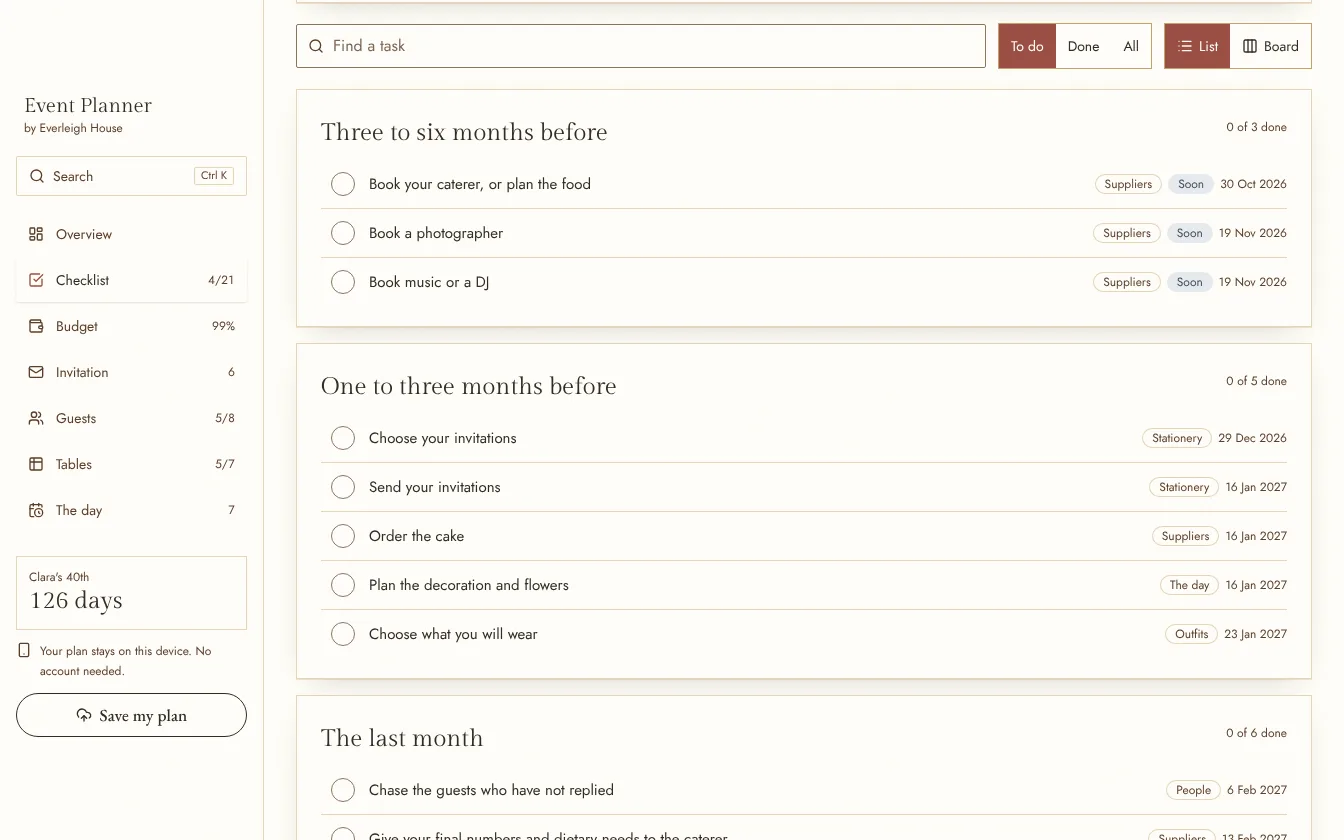
If you start late, book the venue and the food in the same week, send the invitations as soon as the venue is signed, and keep the reply date three weeks before the day.
How do you set an event budget?
Decide the total first, then split it. Agree who pays for what before you book anything, because a deposit is hard to take back. The split below is our starting split for any event. It is guidance, a starting point for you to change, and it does not come from a survey of what hosts spend.
A starting split for an event budget, with a £2,000 example (our guidance)
Food
- Share of the total
- 30%
- Of £2,000
- £600
Venue
- Share of the total
- 25%
- Of £2,000
- £500
Drinks
- Share of the total
- 12%
- Of £2,000
- £240
Music
- Share of the total
- 7%
- Of £2,000
- £140
Photography
- Share of the total
- 6%
- Of £2,000
- £120
Decoration
- Share of the total
- 5%
- Of £2,000
- £100
Flowers
- Share of the total
- 4%
- Of £2,000
- £80
Invitations and stationery
- Share of the total
- 3%
- Of £2,000
- £60
Cake
- Share of the total
- 3%
- Of £2,000
- £60
Outfits
- Share of the total
- 2%
- Of £2,000
- £40
Contingency
- Share of the total
- 2%
- Of £2,000
- £40
Favours
- Share of the total
- 1%
- Of £2,000
- £20
The venue, the food and the drinks take two thirds of the total, because a warm room, a good meal and a full glass are what guests feel. If the venue asks for a minimum spend on food and drink, merge those lines. Keep the contingency, however small: an extra hour, a corkage charge and a taxi home for a grandparent all arrive late.
How do you keep a guest list with replies and dietary needs?
Keep one list, with a row for each household and a line for each guest in it, so that every reply has a place to land. For each guest, keep five things:
- The name, spelled as it goes on a place card.
- A way to reach the household: a phone number or an email address.
- The reply: coming, not coming, or no reply yet.
- Any dietary need or allergy, in the guest’s own words.
- A note for anything else: a wheelchair, a high chair, a guest who must leave early.
Pass the allergies to the caterer exactly as the guests wrote them. A caterer can work with “no sesame, it is serious”. “Allergies: yes” helps nobody. Chase the households with no reply on the reply date, so that you have a week to fill the gaps before the caterer needs the final list.
How do you write a timeline for the day?
Write it in the order the day happens, with a time on each line, and send it a week before to everyone with a job: the venue, the caterer, the music and the friend who is bringing the cake. Here is a sample for 60 guests from 7pm, with a toast before the meal: about an hour of drinks, ninety minutes for the meal, then the cake and the music.
A sample timeline for a party of 60 guests from 7pm (our guidance)
6pm
- What happens
- Final set-up and a check of the room
- Notes
- Flowers, decoration, music and the seating plan
7pm
- What happens
- Guests arrive, with drinks
- Notes
- About an hour before anyone sits down
7.50pm
- What happens
- A welcome and a toast
- Notes
- A few words from the host, about ten minutes
8pm
- What happens
- Guests take their seats and the meal is served
- Notes
- About ninety minutes
9.40pm
- What happens
- The cake
- Notes
- Ten minutes after the meal ends
10pm
- What happens
- Music and dancing
- Notes
- Move a few tables to the edge of the room
Midnight
- What happens
- Goodbyes
- Notes
- Check the latest finish with your venue
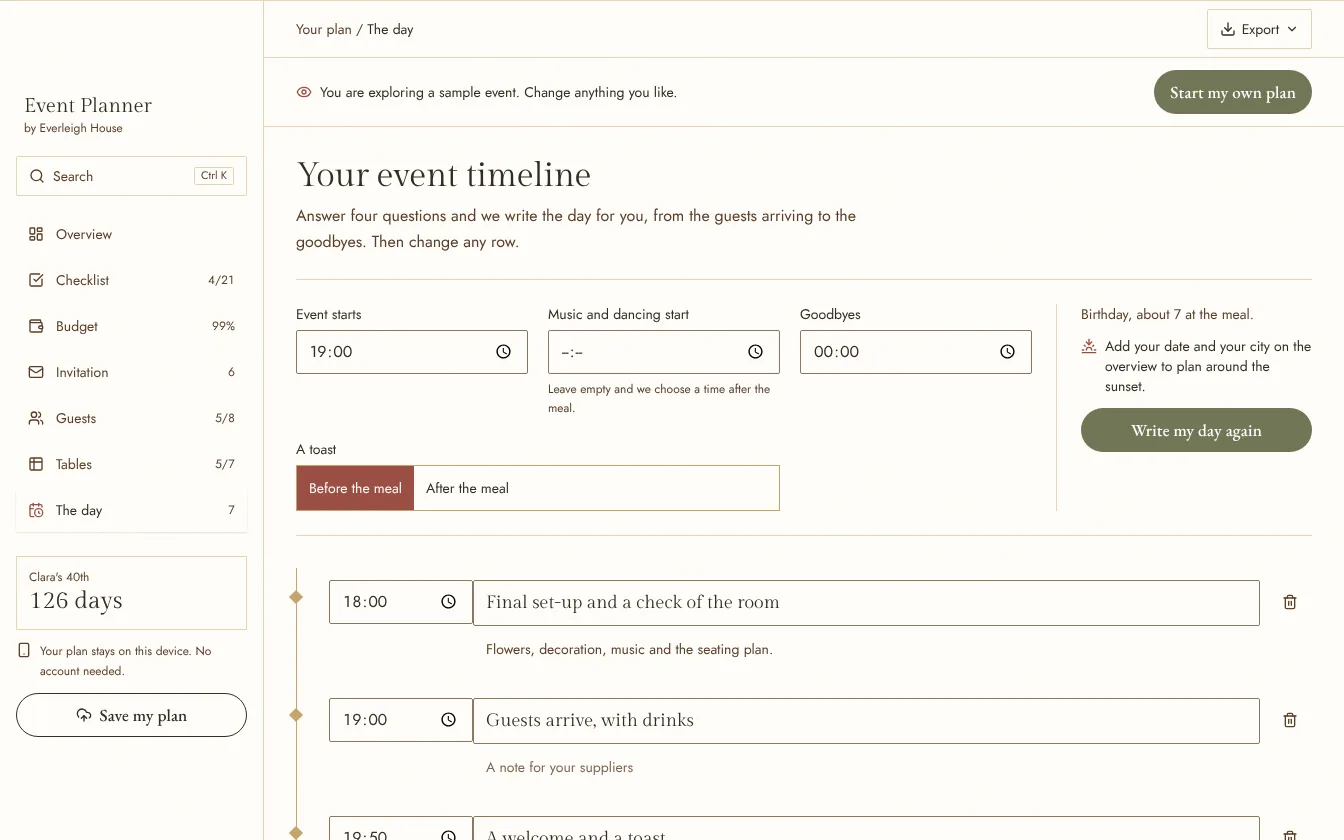
Serve the food on time, because a late meal is what guests talk about on the way home. And give each line an owner: who lights the candles, who starts the music, who calls the taxis.
What changes if the event is a wedding?
A wedding adds the notice of marriage, the registrar or the officiant, and a longer lead time for almost every booking. For a wedding, use the wedding checklist, which counts back from the day with the legal steps for each part of the UK, and read when to send wedding invitations in the UK for the stationery dates.
Questions hosts ask
How far in advance should you plan an event?
About three months ahead for a party in a hired room, and four to six months for a milestone birthday, an anniversary or a popular venue. Send the invitations six weeks before and ask for replies three weeks before.
What should you decide first when you plan an event?
The date, the budget and the guest number. The guest number decides the size of the room, the room decides which dates are free, and the budget decides both. Book nothing until the three agree.
How much of an event budget should go on food and drink?
Our guidance is about 30% for the food and 12% for the drinks, with another 25% for the venue. With a minimum spend on food and drink, count that spend as the venue and the food together.
When should you send thank-you notes after a party?
Within two weeks, while you still remember who brought what. A note by hand or a message in your own words both count, if each one names the gift or the help.

Plan it in one place
Plan your event, free
The checklist, the budget, the guest list with replies, the tables and the plan for the day, together in one place. No account needed, and your plan stays on your device.
Keep reading

Planning
How far ahead to plan a party in the UK, and when to send the invitations
Start dates, venue bookings and reply dates for seven kinds of party, with what 50th birthday venues ask and when to book a work Christmas party.

Planning
Where to spend your wedding budget, and what nobody will miss
Photographs and film first, then the food and comfort your guests feel, then the cuts nobody notices: a clear order for the money, line by line.

Planning
What a UK wedding costs in 2026, line by line
Two national surveys side by side, the average for each supplier, the real cost of one more guest, and a budget method with room for surprises.

Planning
A UK wedding planning timeline, from 18 months out to the day after
What to book, send and sign at 18, 12, 9, 6, 4, 3 and 2 months, with the legal notice, the reply date and a plan for engagements under a year.