Etiquette
One invitation, two languages, no one left reading a translation
7 min read
By Helen
Bilingual wedding invitation wording, made simple: which language leads, how to keep names and dates the same, and who must check the translation.
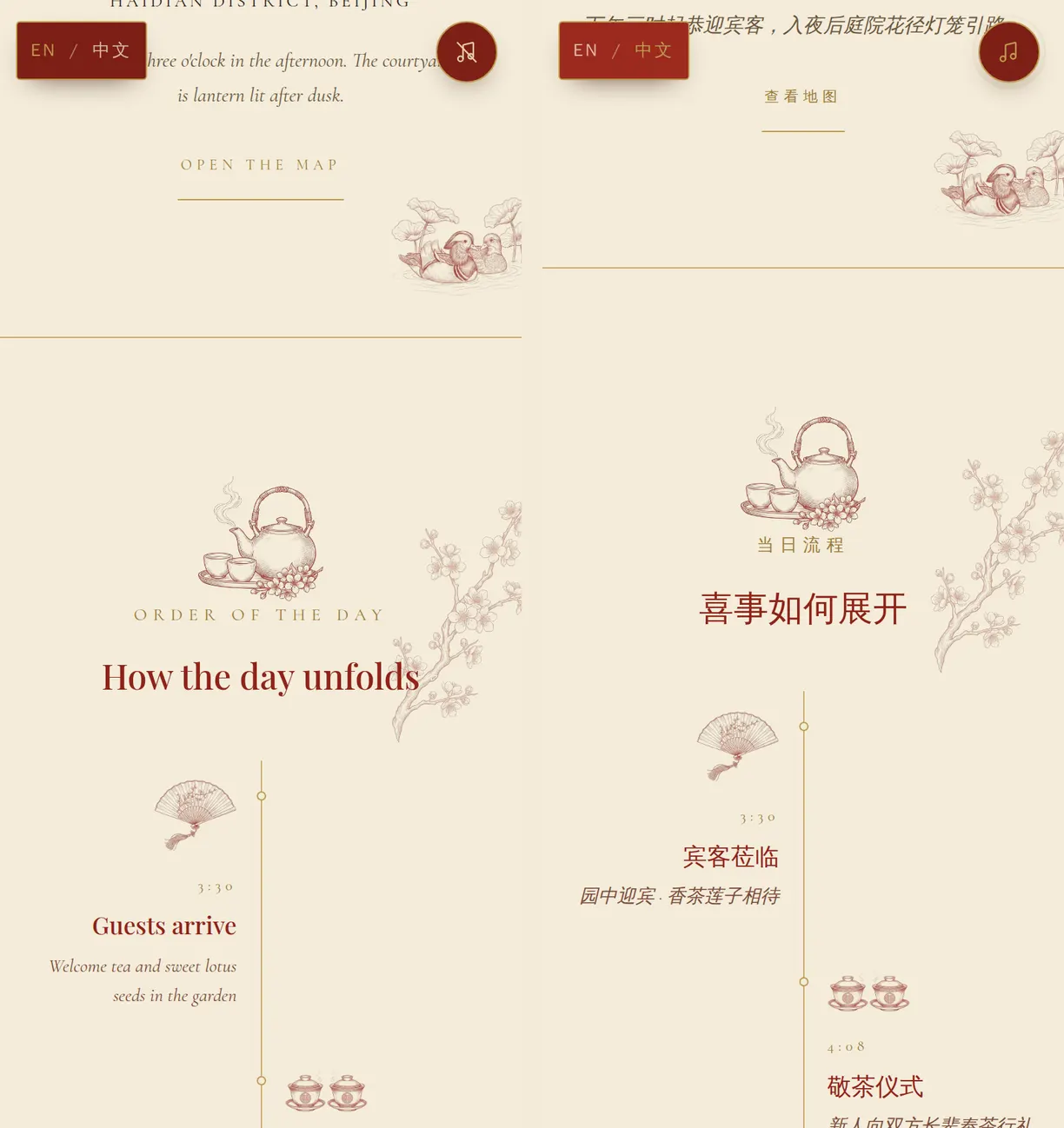
You can get a bilingual English and Chinese digital wedding invitation from Everleigh House, a London studio that designs digital wedding invitations: in our Chinese Happy Xi collection, each guest switches between English and 中文 in place, and you choose which language opens first. Every package includes any two languages at no extra cost, and the translation is included.
The rest of this post is about the wording, and it holds for any pair of languages and any supplier. Decide first which language leads. Then set the second language in full, line for line, so that nobody receives a summary of an invitation that someone else got in full.
Which language should lead on a bilingual invitation?
The leading language is the one a guest meets first. On paper it sits at the top of the card or on the left. On a screen it is the language the invitation opens in. On your own invitation, you choose which language opens first, and a guest who needs the other language switches to it in place. Our public demos open in English.
Families notice this. A grandmother who reads only Chinese, and who finds her language second and in smaller type, may draw her own conclusions about where she stands. So ask one plain question before you write a word: who would be most hurt to find their language second? Often the answer is the older generation on one side, and the decision makes itself.
If both sets of parents feel strongly, choose a layout that gives the two languages equal weight. That saves you an argument you do not need four months before the wedding.
Side by side, one after the other, or a switch?
There are three common layouts for a bilingual invitation.
| Layout | How it works | Where it suits |
|---|---|---|
| Side by side | Two columns, one language in each | A short card with few lines. On a phone the columns become narrow. |
| One after the other | The full text in one language, then the full text in the other | Paper, or a short digital invitation. The second language can feel like an appendix. |
| A switch | The whole invitation in one language, which the guest changes in place | A digital invitation with chapters (the story, the day, travel, what to wear), where each guest reads every chapter in their own language |
The switch is the layout that paper cannot offer. Chinese Happy Xi switches between English and 中文, and Blanc Garden switches between English and Spanish. The Wedding Times, our newspaper collection, prints the whole paper in English or German at one tap. In each one, a guest who reads only one of the two languages still gets the whole invitation. These are the pairs in our demos. You can choose any two languages, and we design in both.
How do you keep names and dates identical in both languages?
The words around a fact can change from one language to the other. The fact itself must not. Before anything goes to a translator, write one short fact sheet: both full names, the parents' names if they appear, the date, each time, the venue, the address and the date you need replies by. Check every version of the invitation against that sheet, line by line.
Names. A Chinese name puts the family name first and the given name second. Decide, for each person, how their name appears in each language: in Chinese characters, in a romanised form, or both. Then use that form every time. Spanish names often carry two surnames, the first from the father and the second from the mother. If the bride's mother is María López García in English, she must not become María López in Spanish.
Dates. Write the date in words in each language. Numbers alone are a trap: 06/07/2027 is 6 July to a guest in London and June 7 to a guest in New York. Here is one date in three languages:
- English: Saturday 12 June 2027, at four o'clock in the afternoon
- 中文: 2027年6月12日(星期六)下午四点
- Español: sábado, 12 de junio de 2027, a las cuatro de la tarde
The Chinese line runs year, month, day, which is the reverse of the English order. Pick the 12-hour or the 24-hour clock for each language, and keep to it on every chapter.
What should you translate, and what should you leave alone?
Translate everything a guest has to understand or act on: the invitation line, the order of the day, what to wear, travel notes and every question on the reply form. A guest who reads only Chinese must be able to reply without asking a cousin for help.
Leave proper names as they are. The venue keeps its own name, in its own language. Write the address exactly as a taxi driver or a map app needs to read it, in the language of the country where you marry. If a guest needs more help, add a short note in their language beside the address, such as which entrance to use or which station is nearest, and have that note checked too.
Choose the script before you choose the words. Chinese is written in Simplified characters in mainland China and Singapore, and in Traditional characters in Hong Kong and Taiwan. Ask the family which one their guests read. The same invitation line looks like this in each:
- English: We warmly invite you to celebrate our wedding.
- Simplified Chinese: 诚挚邀请您参加我们的婚礼。
- Traditional Chinese: 誠摯邀請您參加我們的婚禮。
Spanish asks a different question: the familiar tú or the formal usted. Ask your Spanish-speaking family which one their older relatives expect, because the verb changes with it:
- Familiar: Nos encantaría que nos acompañaras en nuestra boda.
- Formal: Nos encantaría que nos acompañara en nuestra boda.
Both mean "We would love you to join us at our wedding." One letter separates them, and the right relative will notice it.
Who should check the translation?
A native speaker of the second language, every time. Ask for a translator who works into their own native language, and do not trust an online tool alone: it misses the nuance that a guest hears at once. A machine can give you a rough first version. A person who grew up reading the language must check every line before a guest sees it.
At Everleigh House the translation is included, so you do not have to find a translator. You still need one reader you trust. Choose a relative who reads the language every day and who will tell you the truth, then give them the fact sheet as well as the text. Ask them to read your design on a phone, the way the guests will, and not only in an email or a document.
Joseph, Co-Founder, a native Chinese speaker, checked the Chinese and Spanish lines in this post.
What do you send to your designer?
At Everleigh House, a person sets every word inside the collection. Write your wording in the Writing Desk, in the language you are most at home in, and add your fact sheet. The translation into your second language is included. If a relative has already written some lines in that language, add them too, so that the family's own phrasing survives. If anything is unclear, your designer asks in your thread before your first design. When the design arrives, your trusted reader checks the second language before you approve it.
Mistakes still happen, in any language. A correction of a fact (a name, a time, a place or a spelling) never uses one of your rounds of changes, and names, times and places are corrected free until the day.
If you are still deciding which language should lead, open Chinese Happy Xi or Blanc Garden on your phone, switch the language, and read it as your most particular relative would. You will know quickly whether the second language reads like an invitation or like a translation.
See one for yourself
Open any collection on your phone. It is the same experience your guests will have.
See the collectionsKeep reading
Style
Front-page news: how to make a newspaper invitation that people read
A newspaper wedding invitation can be digital or printed. How to set the masthead, columns and headlines, and what to write in each part of the paper.
Style
A Lake Como wedding, and the invitation that belongs to it
A Lake Como wedding invitation asks for restraint: ivory, a little gold, engraved type. Here is what guests flying to Italy need from it, too.
The House View
Why an invitation should open on something closed
An animated wedding invitation should open like a letter: one tap, a few seconds, and then every detail your guests need. Here is what to look for.
Etiquette
Is a digital invitation proper enough for our wedding?
Are digital wedding invitations acceptable, even for a formal wedding? Usually yes. Here is when paper still wins, and what to tell the family.
The House View
Digital invitations that still feel like heirlooms
Why a paper invitation feels special, and how a digital wedding invitation can keep that feeling while it does far more work for you and your guests.
Etiquette
How to word your invitation, beautifully
Who to name first, how to phrase the request, where the dress code goes and what the reply line says: wedding invitation wording, with lines to copy.
Planning
Choosing a collection that matches your venue
A lake, a walled garden, a city hotel: how to choose a wedding invitation design that suits your venue, and how to decide when you like two of them.