Style and trends
Chinese wedding invitation etiquette: red, gold and double happiness
7 min read
Updated
Red and gold, the double happiness character 囍, whose names to print and how families choose a date: Chinese invitation etiquette, explained.
Chinese wedding invitation etiquette starts with colour and character: the card is traditionally red and gold, and it carries 囍, the character for double happiness. It often names both sets of parents as well as the couple, and when the two families read different languages, a single bilingual invitation can serve them both.
The details depend on whose family you ask. Singapore’s National Library Board notes that Chinese wedding customs generally vary according to dialect group, and families from mainland China, Hong Kong, Taiwan, Malaysia and Singapore can hold different expectations again. So read what follows as a list of questions to take to your parents, and let them correct it.
Joseph, our co-founder and a native Chinese speaker, reviewed the customs and the Chinese in this note.
Why are Chinese wedding invitations red and gold?
Red is the colour of good fortune and happiness at a Chinese wedding, so the invitation follows the bride’s dress: a red card with gold lettering, or a pale card with red and gold detail. The National Heritage Board’s page on Chinese weddings in Singapore describes the kua, the traditional red wedding dress embroidered with auspicious symbols, and says that its red symbolises good fortune and happiness.
The colours to handle with care are the colours of mourning. The National Library Board notes that white or black garments are now commonly worn for mourning. That matters if one side of your family pictures an ivory card with black ink and the other side does not. In our experience, a cream card with red and gold detail suits both sides, but ask an older relative before you decide. Their answer settles it.

What does 囍 mean on a wedding invitation?
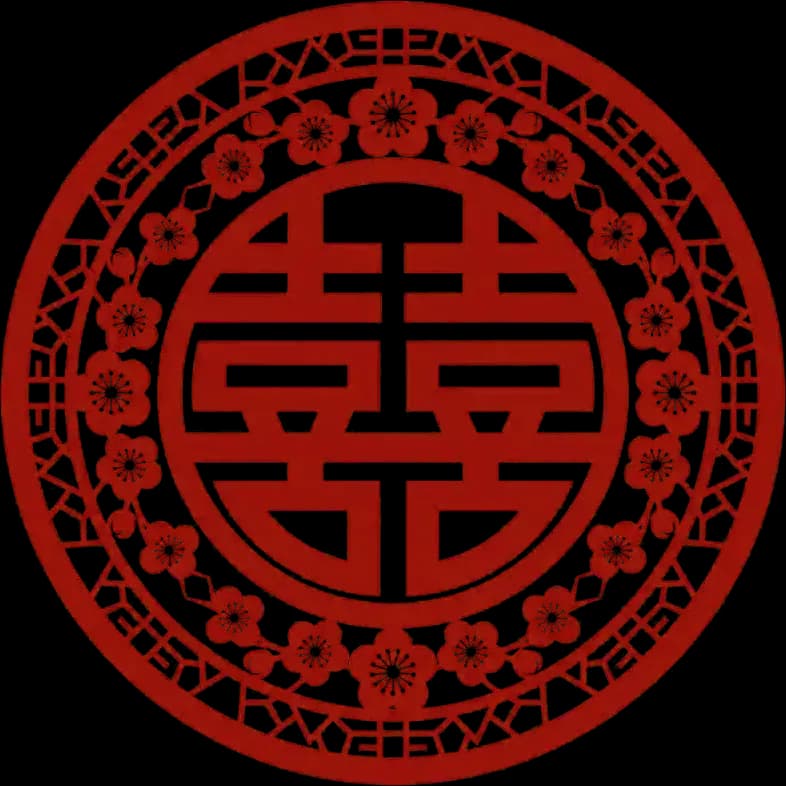
囍 is the character 喜, which means joy, written twice and joined into one square character. It is read shuāngxǐ, double happiness, and it belongs to weddings: you will see it on the decorations, on gifts for the couple and on the invitation itself.
One practical warning. The character has a precise form, and a near miss is easy to make and easy for a Chinese reader to spot. Ask a person who reads Chinese to check it at full size on the finished invitation, the same way you would check the spelling of a name.
Whose names go on a Chinese wedding invitation, and in what order?
In many traditional families, the invitation goes out in the names of the parents, and it gives the full names of both sets of parents and of the couple, often with their Chinese names. It is a mark of respect to the parents, who are often the hosts. Some couples now host in their own names instead.
The order of names follows seniority in the family, and families can disagree about the details. Before anyone writes a word, agree three things with both families: who hosts, whose names appear, and in what order. Then decide how each name is written. A Chinese name puts the family name first and the given name second, so a name that reads correctly in English can look backwards in Chinese if it is copied across without thought.
What to settle with both families, and when
The wedding date
- Who usually decides
- Both families, often with the almanac
- Settle it
- Before you book the venue
Who hosts
- Who usually decides
- The parents, or the couple
- Settle it
- Before any wording
Whose names appear, and in what order
- Who usually decides
- Both families
- Settle it
- Before any wording
Simplified or Traditional characters
- Who usually decides
- The family who will read them
- Settle it
- Before you brief a designer
Whether the tea ceremony is on the invitation
- Who usually decides
- The couple, with their parents
- Settle it
- Before you brief a designer
How do families choose an auspicious wedding date?
Many families choose the date with the Chinese almanac, 通勝 in Cantonese and 通书 in Mandarin, which marks the days that are good or bad for a wedding. Some also consult a fortune teller, or match the date to the couple’s birth details. The almanac often guides the betrothal as well: the National Library Board describes the betrothal gifts (guo da li) being presented on an auspicious day picked from the almanac, one to two weeks before the wedding.
For a wedding in the UK, settle the date with both families before you book the venue. If the almanac’s best Saturday is already taken at your venue, it is better to know that in January than in June.
Should the invitation mention the tea ceremony?
Mention it on the invitation only if every guest is invited to it. The tea ceremony is a family rite. The National Heritage Board describes a ritual held at the groom’s home on the wedding day, where the couple offer cups of tea to the senior members of the groom’s family, and the elders give a hongbao (red packet) or jewellery in return. The bride’s family often holds its own tea ceremony afterwards, at the bride’s home. In many families the tea is sweetened with lotus seeds and red dates, and each dialect group keeps its own version.
So decide first who takes part. If the ceremony is for the family alone, tell the relatives who take part directly, with the time and the address, and leave it off the invitation every guest sees. If you want all your guests there, put it in the order of the day with its own time, so that nobody arrives for the banquet having missed it.
How do you word a bilingual Chinese and English invitation?
Decide which language leads, then set the second language in full. A guest who reads only Chinese must find every part of the invitation in Chinese, from the order of the day to the reply. Our guide to bilingual wedding invitation wording covers the layouts and the checks, and our checklist of what a wedding invitation must include gives the facts every version needs.
Choose the script with the family who will read it. Simplified characters are used in mainland China and Singapore, and Traditional characters in Hong Kong and Taiwan. A formal Chinese invitation often closes with a polite request for the guest’s presence, such as 恭候光临, which means “we respectfully await your presence”:
恭候光临
Whatever line you choose, a native speaker must check it. A machine translation can be correct in every word and still sound like a tax letter.
Sit down with both sets of parents, a pot of tea and the table above, and go through it one row at a time before anyone opens our bilingual wording guide.
Questions couples ask
Can a Chinese wedding invitation be white?
It can, with care. Many families link white and black with mourning, so a white card with black ink can worry older relatives. A cream card with red and gold detail usually suits both sides, but ask an older relative before you decide.
Do you have to put 囍 on a Chinese wedding invitation?
It is not required, but it is the most familiar sign of a Chinese wedding, and many families expect to see it. If you use it, ask a person who reads Chinese to check its form at full size on the finished invitation. A near miss is easy to make and easy to spot.
Whose names go first on a Chinese wedding invitation?
In many traditional families, the parents host, and their names come first, followed by the couple. The order follows seniority, and families can disagree on the details. Agree the order with both families before anyone writes a word.
Should the tea ceremony be on the wedding invitation?
Only if every guest is invited to it. If it is for the family alone, tell those relatives directly, with the time and the address. If everyone is welcome, give it its own time in the order of the day.
When you are ready
Create your digital wedding invitation
Choose a design from our collections, and we make it yours: your names, your words, your day. Guests open it on their phone, reply inside the invitation, and every answer lands in your guest list. Two languages at no extra cost. Paid once per wedding, from £149.
Every design opens on your phone as your guests will see it. How it works
Keep reading
Style and trends
Wedding trends for 2027: what will last, and what will date
Twelve trends from The Knot, Pinterest, Bridebook and Zola, the numbers behind each, and a plain verdict on which will still look right in twenty years.

Style and trends
Winter wedding invitation ideas: light, warmth and snow
A warm palette, kind lines about the early dark, the weather and the Christmas trains, and winter wording your guests can read once and act on.
Style and trends
A pearl wedding theme, built around one family heirloom
What pearls mean at a wedding, the colours that flatter a real strand, and how to wear, carry or show an heirloom so that it leads the whole day.

Style and trends
Front-page news: how to make a newspaper invitation that people read
A newspaper wedding invitation can be digital or printed. How to set the masthead, columns and headlines, and what to write in each part of the paper.